
Pipeline

AVGN7 is currently being developed to treat inclusion body myositis (IBM), heart failure, and sarcopenic obesity. The AVGND+AVGN7 combinatorial is being developed to treat Duchenne muscular dystrophy (DMD).
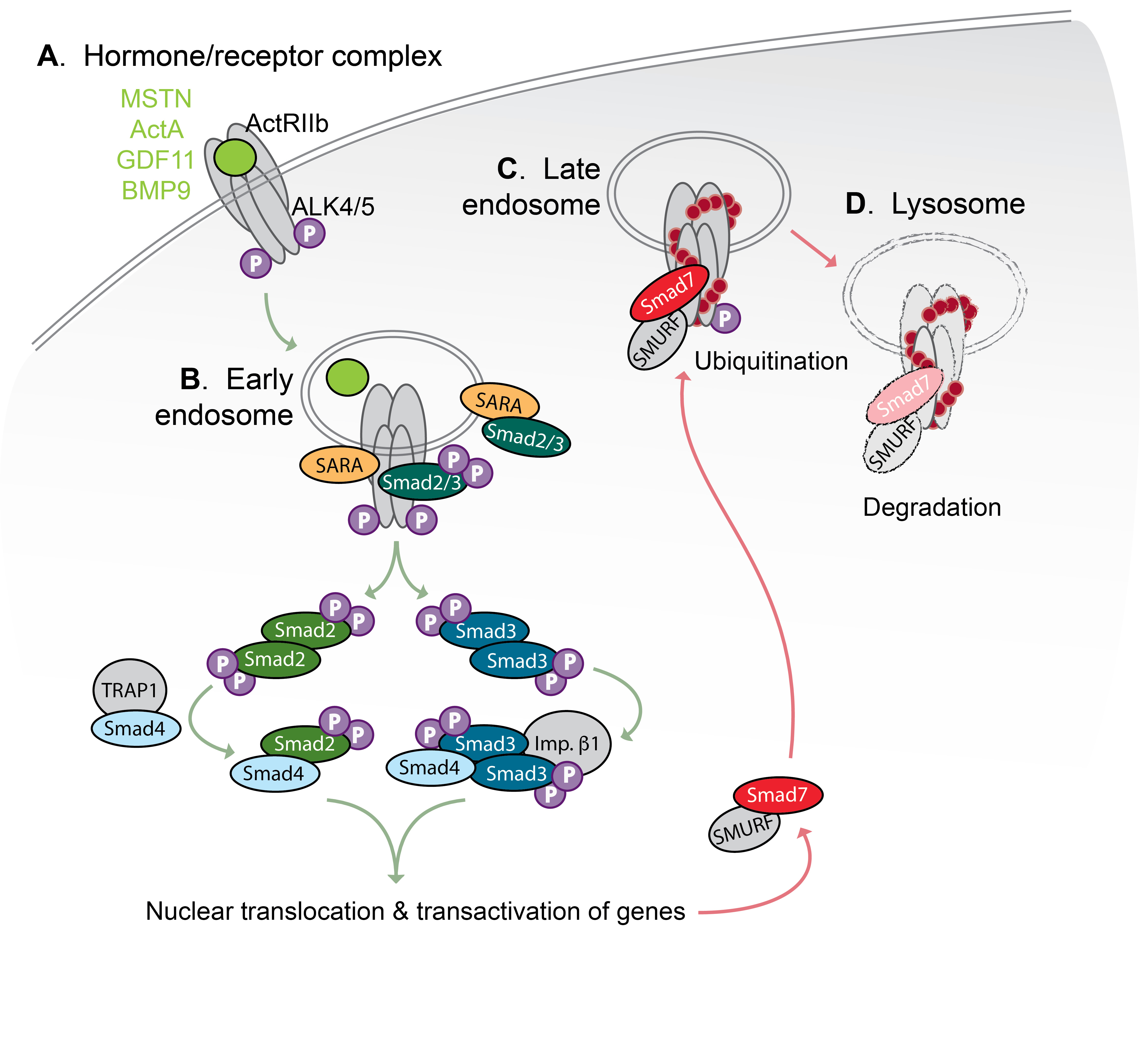
Smad7 and muscle hypertrophy
Various hormones or ligands (A) bind myostatin/activin receptors (ActRIIb). The serine-threonine kinase ALK4/5 is then recruited to ActRIIb and phosphorylates Smad2 and Smad3 (B). These transcription factors separately form complexes with Smad4 to activate gene expression of the E3 ubiquitin ligases MuRF1 and MAFbx. These factors then stimulate protein degradation and as a result, muscle wasting.
Smad7 expression is also stimulated by this pathway. This "inhibitory Smad" targets ActRIIb for ubiquitination (C) and ultimately degradation (D). It is the ultimate ActRII-attenuator as it blocks Smad2/3 signaling regardless of which ligand activates them.
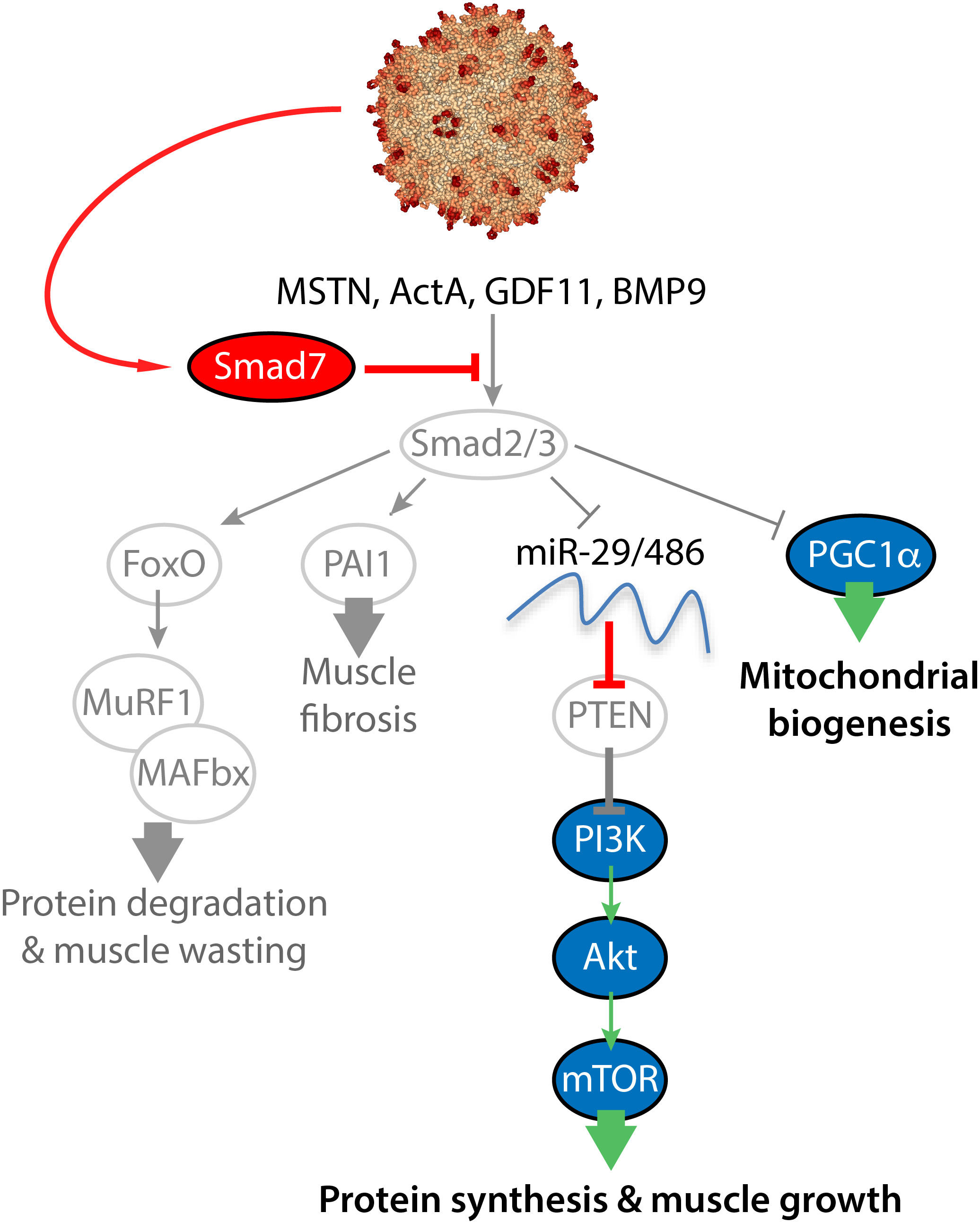
AVGN7 prevents muscle wasting, enhances muscle mass and strength
AVGN7 transfers the Smad7 gene into muscle. Smad7 protein is then produced, blocking the actions of myostatin (MSTN) and other ActRIIb ligands that inhibit muscle growth through Smad2 and Smad3. Because these pathways are deactivated, neither can degrade muscle protein or cause fibrosis (gray).
Smad2 and Smad3 normally inhibit expression of miR-29 and miR-486, which block an inhibitor of the PI3K-Akt-mTOR pathway. Smad2/3 also inhibit PGC1a. Thus, Smad7's inhibition of Smad2/3 activates pathways that increase muscle protein synthesis, muscle growth and mitochondrial biogenesis.

AVGND
AVGND restores muscle structure and prevents degeneration by delivering a "micro-dystrophin" gene. The resulting protein is smaller than dystrophin, but is composed of the same building blocks including N- and C-terminal regions, hinge (H) domains and spectrin repeats (R). Treating muscle with AVGND prevents degeneration as well as the loss of muscle mass and function.

AVGND+AVGN7 combinatorial therapy for DMD
Restoring muscle structure alone, regardless of dystrophin-targeting technology, can only prevent future muscle degeneration. It cannot restore muscle lost to necrosis, remove fibrosis or compensate for these and other pathologies that accumulate over time.
A combinatorial approach, however, one featuring both AVGND and AVGN7, is optimized to restore muscle to a healthy condition by preventing degeneration AND restoring muscle mass and strength. It was also designed to help subjects with advanced disease progression, those who are far less likely to benefit from simply restoring dystrophin.
AVGN7, a platform therapeutic suitable for treating a myriad of disease indications
Heart failure, sarcopenic obesity and of course, other muscular dystrophies and myopathies all activate similar degenerative pathways that cause muscle wasting. AVGN7 is being developed to treat some of these indications alone while future studies and partnerships will explore additional combinatorial approaches. Click the link to the right to learn more about muscle wasting diseases.